
Who Joined the Gathering?
Our 2025 Community Knowledge Matters Gathering was a wonderful day of connection and conversation. To reflect on our progress, we wanted to share a breakdown of who attended and what these insights indicate about the composition of the CKM network so far.
A Growing Rural and Island Focus
As was our aim, the majority of attendees (approximately 59%) joined us from rural and island Scotland. This suggests the CKM network is evolving towards a wider rural and island focus. While the network initially began in 2023 with a specific focus on the Highlands and Islands and mental wellbeing based on our integration with the Ideas Fund, as of November 2025, our scope has broadened to foreground rural and island communities across the whole of Scotland interested in community-led research more widely.
Based on registration data, the Gathering brought together a diverse mix of roles. Whilst a key value of the network is to break down the binaries and barriers between roles, to ensure attendance was community focused we did ask what primary role people were joining in with.
55% identified primarily as community members, organisation members, or third-sector workers.
20% identified as researchers affiliated with an academic institution.
18% identified as practitioners or students.
6% identified as decision-makers.
This variety indicates that the wider network - at time of posting, consisting of 318 members - is built on a rich blend of identities and roles within the community-led research landscape and bringing different perspectives together.
Insights From the Day: What Communities Do We Belong To?
At our network events, we like to start by asking people which "hats" they are coming in and which communities they feel part of.
Communities
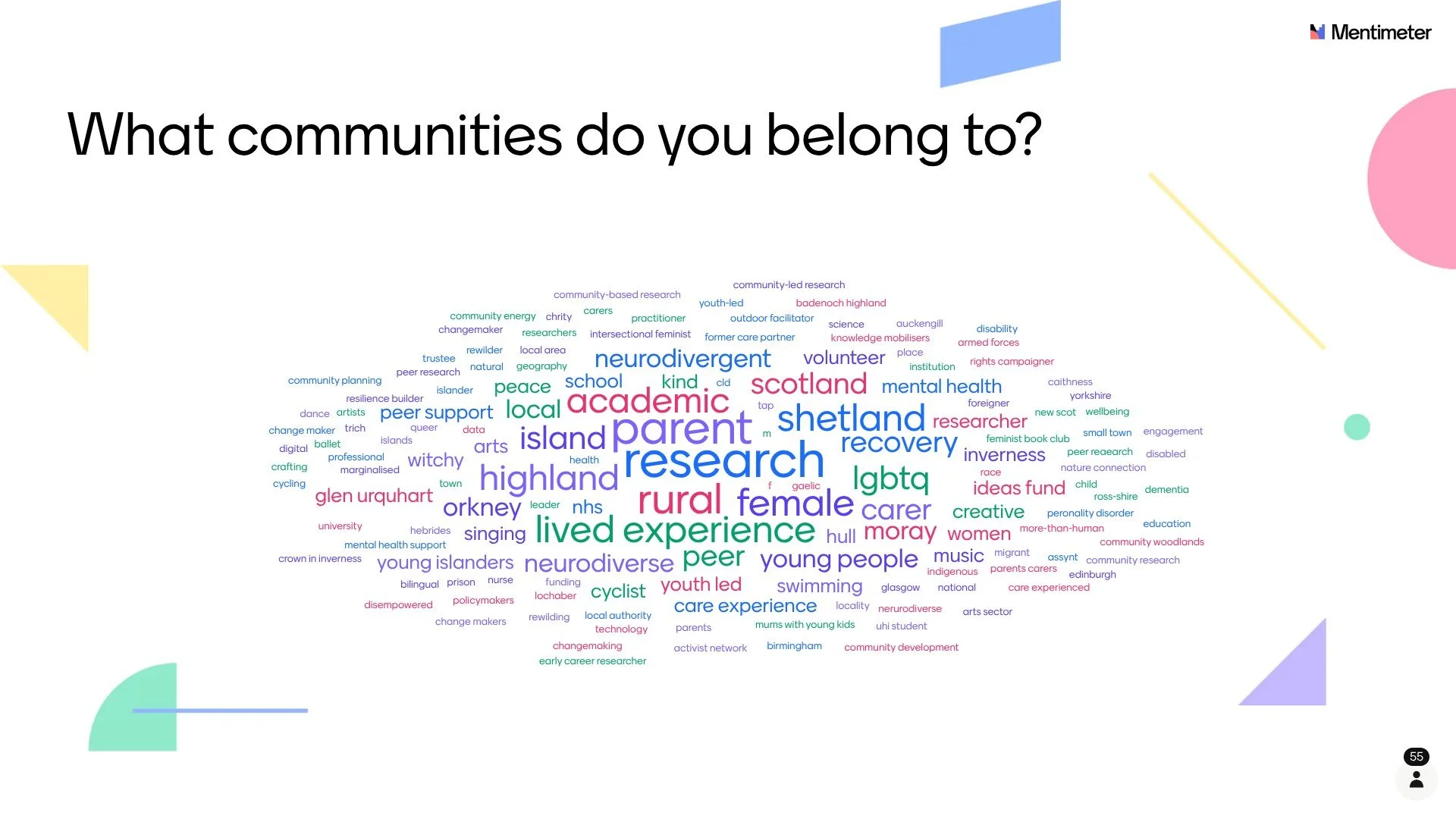
Acknowledging “community” means a lot of different things, we always check in what communities they feel part of. This word cloud summarises their responses for the Gathering.
On the day, we asked attendees what communities they felt part of, with the option to define ‘community’ as they liked: whether by geography, identity, experience, or interest. The bigger the word in the word cloud, the more frequently it was used. Based on our "check-in" exercise, our attendees had a strong engagement from the following communities: parent, research, rural, female, lived experience, academic, Island, Shetland, Highland, LGBTQ, Scotland, local, recovery, peer, Moray, young people, career, and Orkney.
While this is a snapshot of one in-person meeting and does not necessarily represent the entire network, it highlights a vibrant and diverse set of groups engaged in our work.
This is something also collate as part of our peer to peer Community of Practice meetings and members can see what communities that form part of the network year round.
Community ‘Hats’
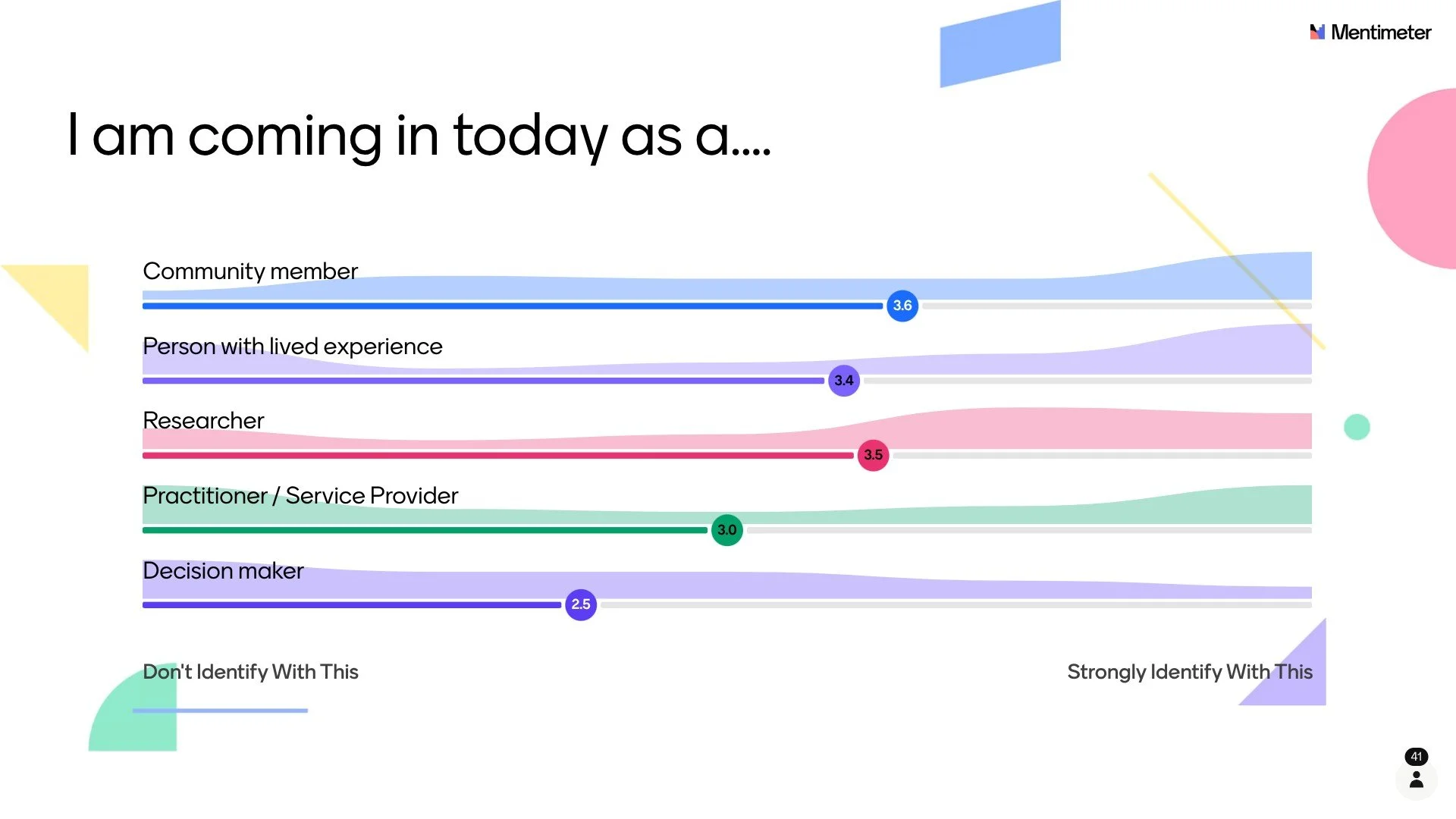
We also asked attendees which 'hats' they were coming into the Gathering with. This graph shows how people identify with each of the categories on a scale from ‘don’t identify at all’ to ‘strongly identify’.
To help break down the traditional binary between "communities" and "researchers," we asked participants to what extent they were coming into the Gathering as: community members, people with lived experience, researchers, practitioners, service providers, or decision-makers.
Crucially, people were able to identify with each of the categories on a scale from ‘don’t identify at all’ to ‘strongly identify’, acknowledging our key value that we often wear multiple hats at once and for example, you can be a community member who is not affiliated with an institution who is a researcher, and that researchers are also part of their communities and have lived experiences too. This is an important whole-self approach we take as a network to encourage people to move past job titles and engage with others in the room through whatever ‘identity’ felt most appropriate to them at the time.
Key Takeaways from 2025
The results of this exercise revealed several important themes:
Centring Community: Most participants identified most strongly as "community members". This aligns with our core mission of centring community perspectives in everything we do.
Merging Roles: To a slightly lesser extent, the check-in results show that people identified with the label ‘researcher’ and the perspective of their own ‘lived experience’. This resonates with our belief that no matter our job titles or status in society, we all have lived experience and are all members of a community. It also indicates many community members do see themselves as researchers, supporting our belief that research can be led by communities rather than just taking place in a university.
The Decision-Making Gap: Fewer people identified as "decision-makers" and this reflects that only 6% primarily registered with that identity. This may suggest many present did not feel as though they have a large amount of opportunities for decision-making.
Experience Levels: Based on registration data, expertise was varied: 27% of attendees had significant experience in community-led research, while 33% had little or no experience at all. The remaining 40% felt they had some experience, suggesting the Gathering also succeeded in our intention in bringing a mix of experience levels together - not to be only preaching to the converted and including those who were completely new, and sharing practice across peers.
Looking Forward
The day included a wide range of perspectives, bringing in both individuals who were completely new to community-led research and those who were more experienced. This mix allowed for a rich exchange of peer support and learning. Interestingly, 43.1% of attendees were not yet CKM members at the time of registration. We welcomed this growth, as our Gathering was intentionally open to anyone passionate about community-led research, regardless of their prior membership status, and continuing to bringing new rural and island perspectives to be interested and supported in doing more community-led research.
The 2025 Gathering was a chance to bring together peers from rural and island communities, practitioners, researchers, and policy-makers to connect and share practice. The day brought together diverse voices—from a community, grassroots, and lived experience lens to policy-makers—to explore how community-led research can drive local change and influence national policy.
Thank you to everyone who made the Gathering such a fruitful and joyful event! We look forward to continuing these collaborative actions as we grow.