
Power and Community-Led Research
how can we foster equitable dynamics within community-led environmental research projects?
How might intermediaries help navigate and balance power dynamics?
To explore these questions, Science Ceilidh and Community Knowledge Matters collaborated with Sophie Kendrick while she was a master’s student at University of Edinburgh and Scotland’s Rural College. We carried out a study to better understand how to navigate power dynamics in community research.
This study focused on exploring the role of an intermediary, which could include providing support to match partnerships between community and researchers, navigating the funding process, developing peer learning opportunities and capacity building. We discussed what has worked well, what has been challenging and what could be developed further.
This study was approved by the University of Edinburgh and SRUC ethics board on 28th April 2025.
Research Process
-
Sophie conducted semi-structured interviews with academic and community researchers who had been involved in community-led research projects supported by Science Ceilidh as an intermediary. She posed questions about the usefulness of intermediaries and experiences of power within participant projects.
Participants were also encouraged to contribute to a zine about this project and power in community-led research overall. Participant contributions included drawings, sketches and photography. These pieces were arranged into the final zine (available below) which was intended to be a creative and accessible form of dissemination.
-
Participation in this study took place under the condition of informed consent. In practice, this meant participants were told why the study was taking place, what would happen with their interview data, what would be asked of them as a participant of the study, as well as why their experience was deemed relevant to the study.
All of the participant information can be found in the participant information sheet below.
-
The interview data were thematically coded utilising NVivo software. The coding themes were derived from relevant major theories of power, which are discussed within the literature review portion of the paper.
Key Findings
We produced a set of recommendations for funders, intermediaries, academic researchers, and communities.
We found that
Power impacts the community-led research process, both positively and negatively.
Intermediaries can be effective in supporting community-led research by reducing power inequities within the research process.
Communities should determine how much and what kind of support they receive.
Reflection is essential, especially by those who may possess greater relative power.
Lasting impact and sustainability of the project should be at the forefront.
Funds should be flexible and community-controlled.

Sophie presenting at the CKM Gathering. Image credit: Alexander Williamson.
We shared more about the project with the Community Knowledge Matters network at the CKM Gathering in November of 2025 in Inverness.
We hope to be able to share the full study and findings later this year.
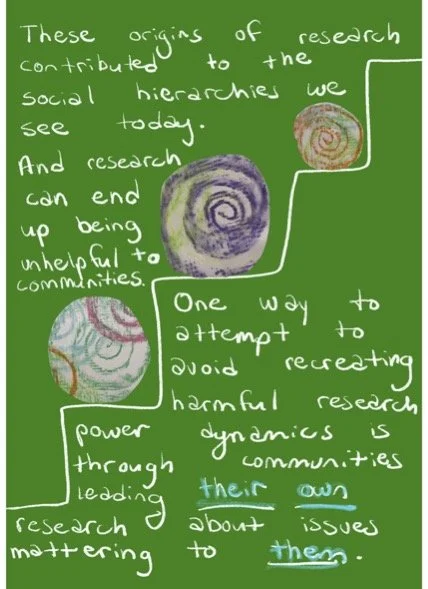
Background information page from the zine
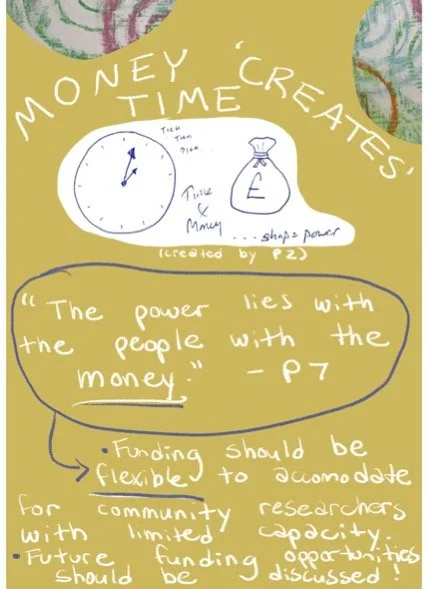
Results page from the zine.
For further information and inquiries, contact sophie@scienceceilidh.com.